As an Amazon Associate, we earn from qualifying purchases. Some links may be affiliate links at no extra cost to you. Although our opinions are based on curated research, we haven't used these products. Articles generated with AI.

What Are the Standard Dimensions of a Pickleball Court?

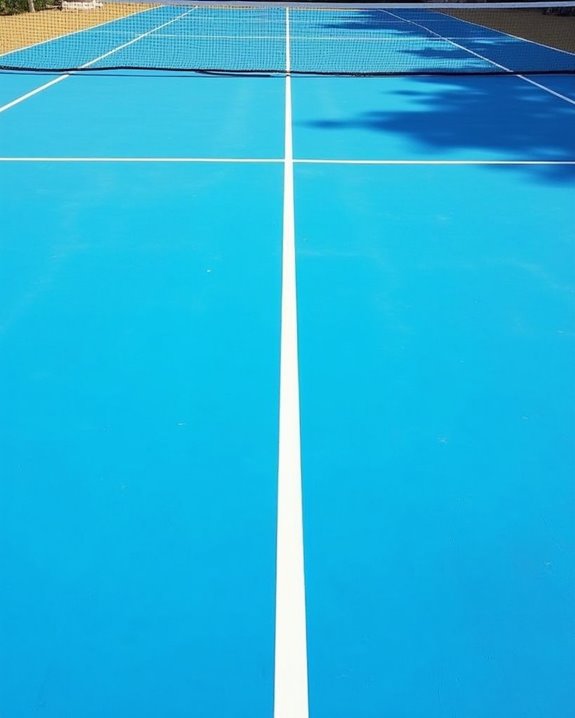
A regulation pickleball court measures 20 feet wide by 44 feet long, with the net standing 34 inches high at center and 36 inches at sidelines. You’ll need to account for the vital non-volley zone (the “kitchen”) extending 7 feet from each side of the net. For safe play, plan for a minimum area of 30 by 60 feet, giving you enough room to serve up those crisp dinks and powerful smashes. Discover how these precise dimensions create the perfect recipe for pickleball’s unique gameplay.
Key Takeaways
- A standard pickleball court measures 20 feet wide by 44 feet long.
- The non-volley zone (kitchen) extends 7 feet from the net on both sides.
- Net height is 34 inches at center and 36 inches at the sidelines.
- Each service court is 10 feet wide by 15 feet deep.
- The minimum recommended total playing area is 30 feet wide by 60 feet long.
The Official Size of a Regulation Pickleball Court
You may be interested


5 Critical Steps To Become A Pro Pickleball Player
April 7, 2025

The court’s layout includes several key ingredients: a net at the center (34 inches high in the middle, rising to 36 inches at the sidelines), service courts on each side, and the essential non-volley zone—often called “the kitchen”—extending 7 feet from the net on both sides.
For a complete playing area, you’ll need more room to move. The minimum recommended playing area is 30 feet wide by 60 feet long, giving players enough space to dash and serve without restriction.
Understanding the Pickleball Non-Volley Zone (Kitchen) Dimensions
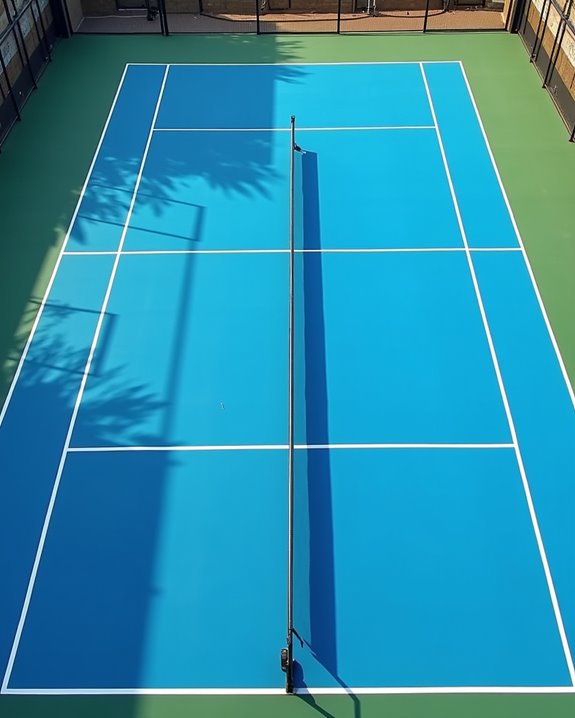
Seven essential feet separate aggressive net play from legal positioning in pickleball’s most strategic area—the non-volley zone or “kitchen.” You’ll find this rectangular restriction extending 7 feet from either side of the net, spanning the court’s full 20-foot width.
This vital court section is highlighted by a 2-inch wide line that’s specially colored to stand out against the court surface. Think of the kitchen as a no-fly zone for volleys—you can’t enter this area to hit a ball before it bounces.
The kitchen’s dimensions create the perfect recipe for strategic play, preventing players from dominating with powerful net shots. Master this space, and you’ll transform from amateur to chef in the pickleball culinary world!
Pickleball Net Height and Width Requirements
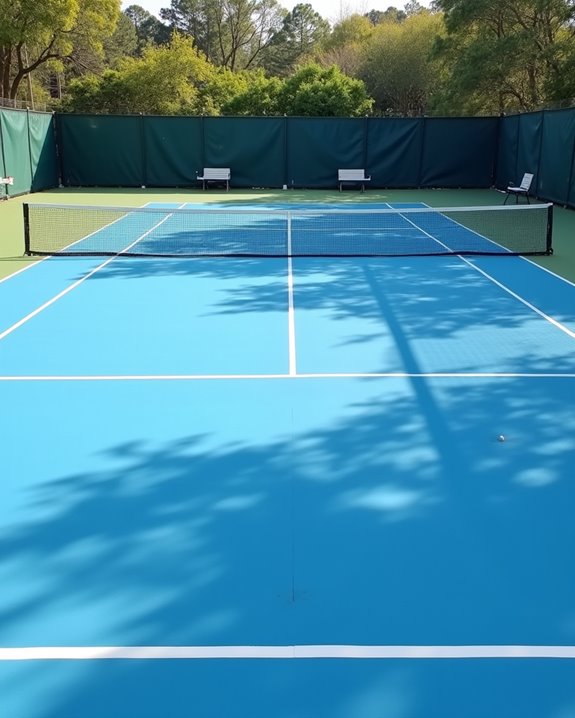
Two vital measurements define every regulation pickleball net: 36 inches at the sidelines tapering to 34 inches at center court. When you’re setting up your court, these pickleball net height specifications aren’t just suggestions—they’re essential ingredients in the recipe for proper play.
Your net must have a minimum width of 21 feet 9 inches from post to post to meet regulation standards. Notice the white 2-inch tape along the top? It’s like the perfect garnish, providing visibility while covering the supporting cable.
Don’t forget the Velcro center strap—it’s the secret sauce that keeps your net properly tensioned at that vital 34-inch center height. Whether you’re playing indoors or outdoors, a quality net should stand up to all conditions, like a well-seasoned cast iron skillet.
Minimum Space Requirements for Safe Pickleball Play
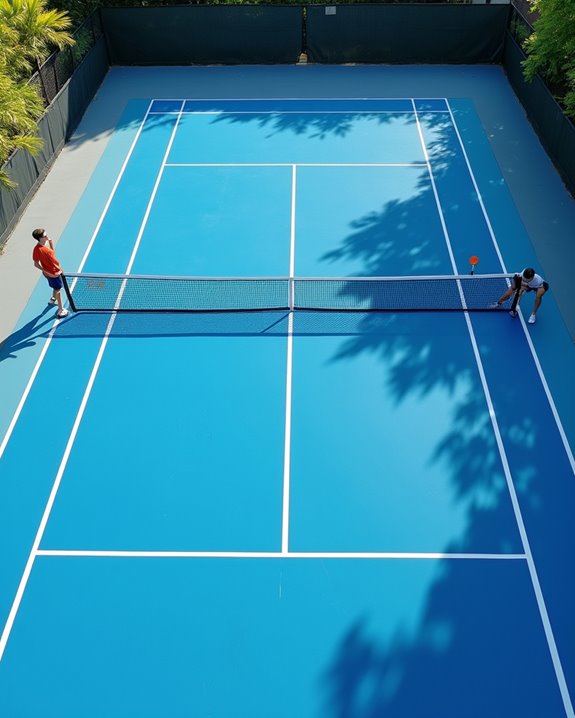
Moving beyond the net specifications, let’s serve up the spatial requirements that’ll keep your pickleball game both safe and enjoyable. The minimum play area for pickleball courts measures 30 feet wide by 60 feet long, giving you ample room to dash and slice across the court.
For truly safe play, you’ll want to fold in a surrounding margin of at least 10 feet behind each baseline and 5 feet on each side—creating total preferred dimensions of approximately 40 feet by 64 feet. This spatial recipe reduces injury risk when you’re sprinting for those just-out-of-reach shots!
Don’t forget that the non-volley zone (or “kitchen”) takes up 7 feet on each side of the net, an essential ingredient in your court dimensions that impacts player movement and overall space requirements.
Recommended Products

🎾CONTAINS 28 MARKERS: 10 yellow I-shaped and orange I-shaped, 4 yellow L-shaped and orange L-shaped.(After receiving it, please press the court sticker firmly on a flat surface for a few minutes to restore its shape.)

EVERYTHING YOU NEED: Our pre-measured pickleball court marking kit includes (2) sidelines, (2) baselines, (2) middle serve lines (2) kitchen lines, and net hash marks, all ready to peel-and-stick. Each kit includes step-by-step illustrated instructions to guarantee a perfectly square, regulation court — even for first-time installers.
Converting Tennis Courts to Pickleball Court Specifications
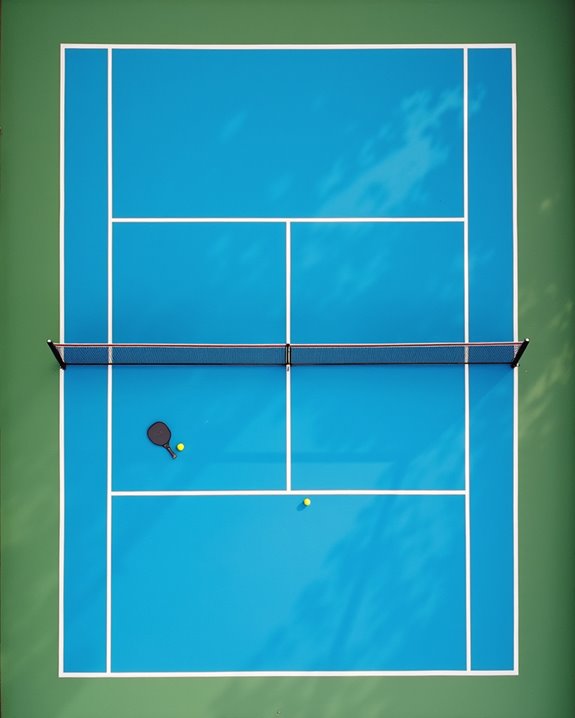
While constructing a dedicated pickleball court might be the dream recipe, transforming an existing tennis court delivers a practical and cost-effective alternative that’ll satisfy your pickleball cravings!
When converting tennis courts, you’ll need to follow precise dimensional specifications. Lower the net to the regulation size of 34 inches at center and 36 inches at sidelines—think of it as reducing the heat on your pickleball simmer. Each pickleball court requires 20 feet by 44 feet, with the existing centerlines of the tennis court serving as your guideline.
Don’t forget to mark the non-volley zone extending 7 feet from each side of the net—this is your “no-fly zone” for proper play. Confirm you’ve got minimum clear space of 10 feet behind baselines and 5 feet on sides for safe, sizzling rallies.
Recommended Products

TRANSFORM any court area into a pickleball court with the Franklin Sports Court Marker Kit. This kit includes all you need to quickly lay out the boundary areas for the game of pickleball in minutes.

【Portable Design】Pickleball court markers with carrying bag, let you outline a regulation official size portable pickleball court. Use this pickleball lines such as driveway, backyard, park, beach or gymnasium.
Includes three pieces of chalk (red, white, blue) to create lane, free throw line, and three-point arc
Creating a Backyard Pickleball Court: Space Planning Guide
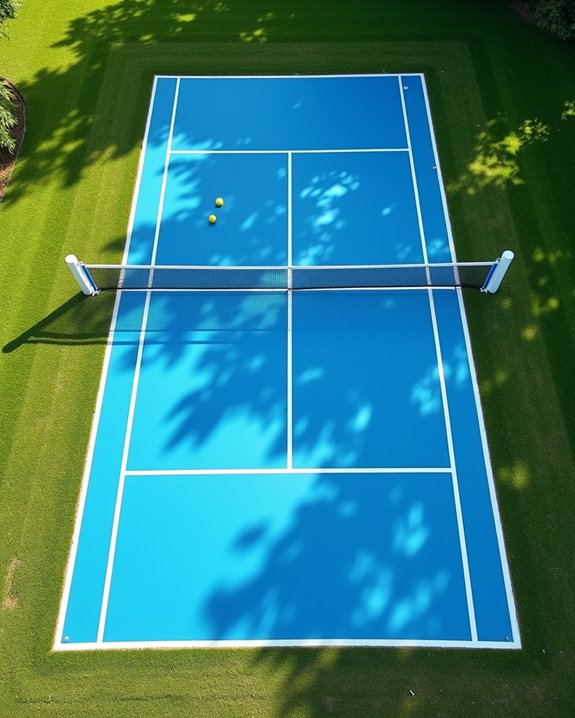
Bringing the sizzle of pickleball to your own backyard requires careful space planning—think of it as prepping your kitchen before cooking a gourmet meal! You’ll need to carve out a generous area of at least 30 feet wide by 60 feet long to guarantee players have room to maneuver.
The actual pickleball court dimensions are 20 feet wide by 44 feet long. Mark your court lines precisely, especially the non-volley zone (the “kitchen”) extending 7 feet from the net on each side. Before you start digging, it’s worth reviewing our full pickleball court cost breakdown to budget accordingly. For the best results, serve up a concrete surface that delivers consistent ball bounce—grass courts can be as unpredictable as a soufflé in humid weather!
Don’t forget proper net height: 36 inches at the sidelines and a slightly lower 34 inches at center—perfect for that crisp, satisfying volley.
Recommended Products

22FT or 11 FT Pickleball Net - BAGAIL's latest portable pickleball net features two nets - a full-size (36 "H x 22'W) USAPA regulation net and an 11'W half court practice net. Quickly assemble the frame system into 22FT or 11FT depending on your needs, and play with family or friends anywhere - in your driveway or on the indoor court. Suitable for players of all ages and skill levels. Whether practicing solo sessions or hosting social games, this 2-in-1 pickle ball net has you covered
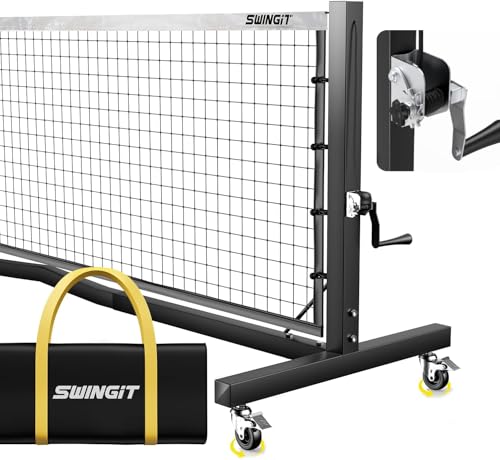
Tournament Performance 22ft Regulation Size: Our pickleball net system meets the official 22ft size as specified by USAPA regulations, with a center height of 34" and a side height of 36". The total length of 22' ensures that this net conforms to official pickleball net dimensions. It's perfect for professional competitions and high-level training

【22 ft or 11 ft Pickleball Net Set】With our net set, the world is in your court! Whether you’re a pro needing regulation size or a casual player wanting something smaller, we’ve got you covered. The 22 ft net is great for full-court matches; the 11 ft version fits quick games or solo practice. Includes a rugged 600D carry bag for easy transport. The set includes one frame and two nets (22ft +11ft).
Pickleball Court Surface Options and Considerations
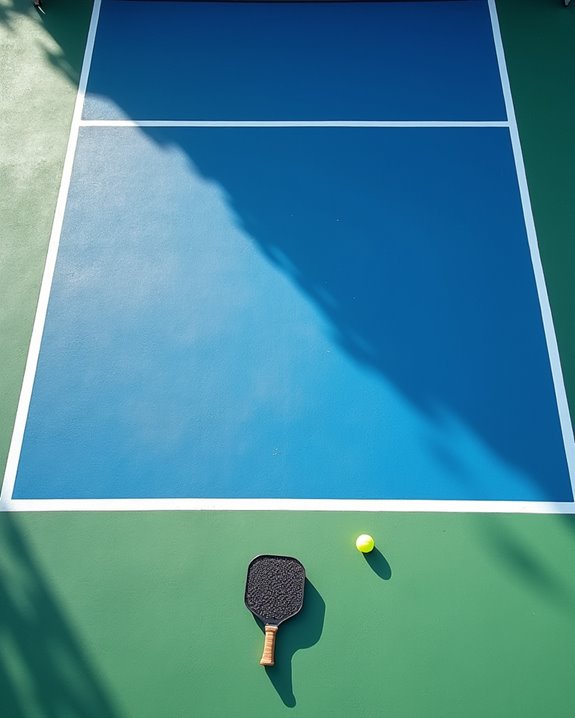
Five distinct surface options await your selection for the perfect pickleball court, each offering its own unique “flavor profile” for gameplay. Concrete and asphalt serve as staple outdoor court ingredients, providing exceptional durability and consistent ball bounce that players can savor match after match.
For indoor courts, polyurethane surfaces offer a perfect blend of comfort and performance – like a well-balanced sauce that complements every playing style. Don’t overlook modular tiles as your quick-prep alternative when permanent installations aren’t feasible.
The surface you choose will greatly impact how the game is “served up” to players. A well-selected court surface enhances both safety and playing experience, just as the right cooking temperature guarantees a dish turns out perfectly every time.
Recommended Products
Includes 1 gallon

STRONG CONSTRUCTION - This pickleball set with net is made of strong 25mm thick steel support frame and all weather net.Fiberglass middle post support,excellent construction.High quality materials prolong the service life
Measuring and Marking Your Own Pickleball Court
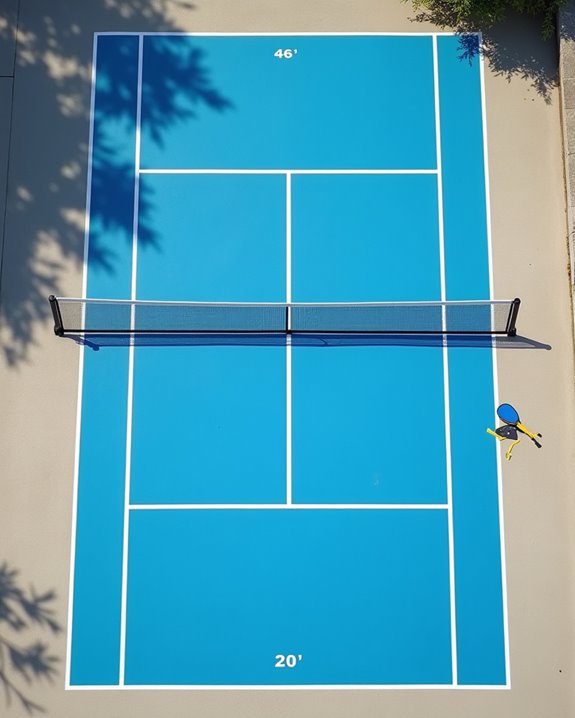
Four simple steps transform any suitable surface into your very own pickleball court, much like following a recipe to create the perfect dish. Begin by measuring 22 feet from the net and mark your first sideline, then extend 20 feet to establish your baseline—similar to creating the foundation of a well-balanced meal.
For the perfect court dimensions, repeat this process on the opposite side, ensuring your sidelines are parallel like perfectly aligned cutlery. Next, measure 7 feet from the net to mark your kitchen zone or non-volley zone, spanning the court’s width.
Finally, use your measuring tape to create a centerline from the non-volley zone to the baseline. For a full step-by-step walkthrough, see our DIY guide to building a pickleball court. For temporary court lines, apply tape or chalk in contrasting colors to the playing surface—like garnishing your culinary masterpiece!
Recommended Products

[Ultra-durable] Define any space quickly and easily with this floor marking vinyl tape. Our pickleball court tape is tough enough to adhere to any floor or hard surface and remain in place. It can withstand high foot traffic and equipment, so you can depend on this floor tape to keep your areas spaced and marked.
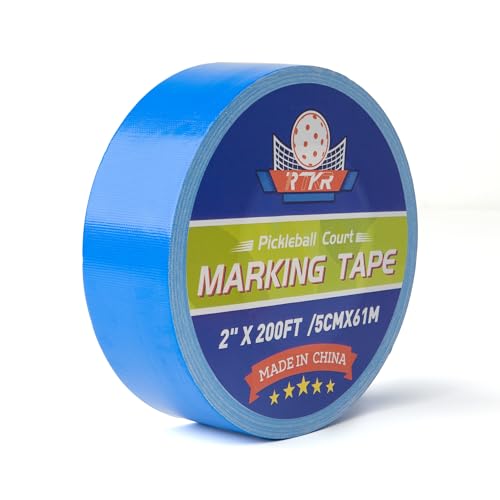
Zero-Residue Removal & Clean Surfaces: Peel away effortlessly leaving absolutely no sticky residue behind. Perfect for protecting gym floors, driveways, and outdoor courts, ensuring a pristine surface every time. (2 inches wide)

ONE ROLL COVERS A FULL COURT - Each 230FT roll is designed to lay out one complete USAPA regulation indoor pickleball court with a little spare. No piecing together short rolls. The current length is 230FT and provides proper coverage for a standard court setup
Frequently Asked Questions
What Is the Smallest You Can Make a Pickleball Court?
For a regulation pickleball court, you’ll need minimum dimensions of 20′ × 44′ for the playing area. While you can create smaller backyard options for practice, the court layout should maintain proper space requirements for authentic gameplay.
What Is the Cheapest Surface for a Pickleball Court?
Asphalt is your cheapest surface option at $15-25 per square foot. You’ll find it’s budget-friendly for outdoor courts, though you’ll face higher maintenance costs long-term. Modular tiles offer an affordable DIY alternative with better durability.
How Much Space Is Needed for an Indoor Pickleball Court?
For your indoor court, you’ll need at least 30’×60′ space with 18-20′ ceiling height. Don’t forget proper lighting, ventilation needs, flooring options, spectator area, storage solutions, clear court markings, and sound insulation.
How Much Does It Cost to Build a Pickleball Court in Your Backyard?
Nearly 70% of homeowners see property value increases! You’ll spend $20,000-$50,000 for quality backyard pickleball court construction, depending on surface material options. Consider local zoning regulations and budget-friendly designs to maximize your home court benefits.